
The Thai backlink market is full of providers. The quality gap between them is wide.
Most buyers still compare price and DA or DR. That is understandable. It is easy to measure. But if you have been building links for years, you already know those numbers are only surface signals.
A DR 40 Thai domain can be strong or completely risky depending on context.
This piece is written for people who already understand backlinks, authority, and off page strategy. The goal is simple. Show what actually separates safe Thai placements from footprint risk.
Why Thai Backlinks Work Differently
The first difference is scale. The pool of genuinely strong Thai language domains is much smaller than in English markets. Once you filter for real traffic, clean link profiles, consistent publishing, and native quality writing, the list shrinks quickly.
Language coherence also matters more.
In Thai SERPs, machine translated or spun content is easier to detect. When a domain publishes awkward Thai or clearly AI translated text, it stands out. Both users and Google notice.
Because the ecosystem is smaller, spam clusters are easier to map. Low-quality networks that link to each other leave visible patterns. When one drops, others often follow.
You cannot treat Thai backlink building as scaled English outreach. The tolerance for weak placements is lower. Local link building in Thailand requires a fundamentally different approach.
Five Signals of a Strong Thai Backlink
No single metric qualifies a domain. We evaluate combinations.
Domain metrics with context
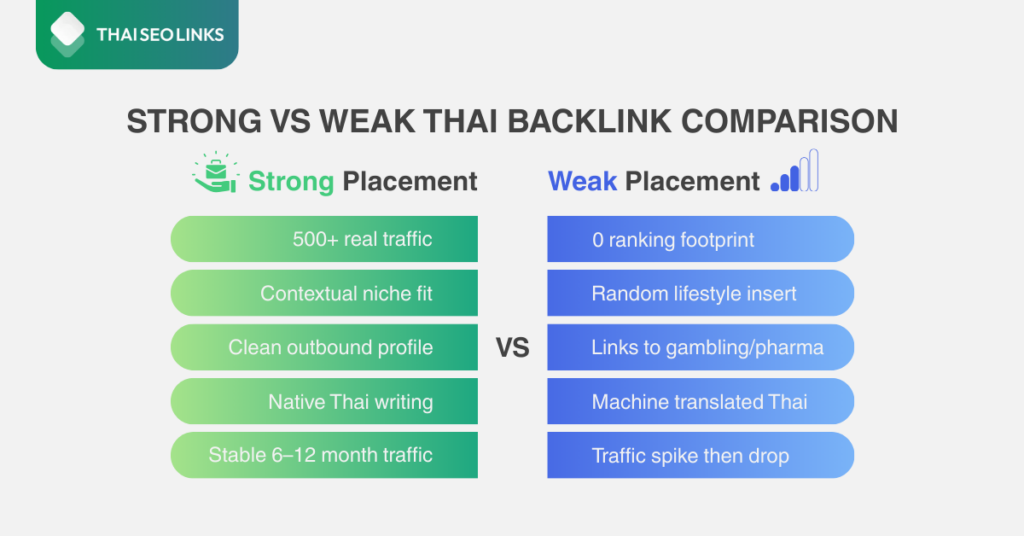
We generally use DR 25 as a minimum baseline. For competitive niches, DR 35 and above is safer. Referring domains should usually be at least 50.
But metrics alone are not enough. We have rejected DR 50 sites because traffic was artificial or the anchor profile was manipulated.
Metrics filter. They do not validate.
Topical relevance
In Thai SEO, relevance is not optional. If a finance brand gets links from unrelated lifestyle blogs, that might pass short term. Long term it weakens topical clarity.
We prefer same niche or clearly adjacent niche placements. The article must make contextual sense. If the link feels inserted rather than earned, we skip it.
Real organic traffic
A site should rank on its own. We check whether it ranks for real Thai queries, whether traffic is stable over six to twelve months, and whether there are signs of past penalties.
As a working threshold, we prefer at least 500 monthly organic visits. For higher tier placements, 1000 plus is more comfortable.
A DR with no ranking footprint is a warning sign.
Link neighborhood
Outbound behavior matters. We review which industries the site links to and how often. If a domain regularly links to gambling, adult, pharma, or aggressive loan sites, we exclude it immediately, behaviors that fall under Google’s link spam policies.
Even one questionable pattern can disqualify a domain.
Native level Thai content
This is where many providers cut corners. We check whether the Thai reads naturally, whether sentence structure feels native, and whether the content is clearly translated from English.
Machine translated Thai is easy to detect if you are fluent. Google can detect it as well.
If the editorial quality is weak, the placement is weak.
Signals of a Low Quality Thai Backlink
Certain patterns repeat in weaker inventories. Too many outbound links per article is one. If a single post contains ten unrelated commercial links, it is not editorial. It is inventory.
Spun or low quality AI Thai content is another. Repetitive structure, unnatural phrasing, literal translations. Those footprints do not age well.
New domains with inflated DR and no historical archive are common. We always check past snapshots. If a domain was something completely different a year ago, caution is justified.
Any site linking to bad industries is excluded automatically. There are no exceptions to that rule.
How ThaiSEOLinks Screens Domains
Transparency is part of the strategy. We start with automated filters. DR threshold, referring domains, traffic minimum, anchor profile review, and basic spam signals. Most domains fail at this stage.
Then we manually review shortlisted domains. Native Thai speakers check content quality. We audit outbound links. We examine archive history. We review traffic patterns over time.
If anything feels off, the domain is rejected.
We reject more domains than we accept. Roughly only twenty to thirty percent of the domains we initially screen enter our active pool.
That is deliberate. The Thai ecosystem is small. Reusing weak sites creates footprint risk quickly. Limiting supply protects long term performance.
A Strong Link Is a Combination of Signals
In Thai SEO, no single number defines quality.
- Not DR alone.
- Not traffic alone.
- Not relevance alone.
The placement must combine clean metrics, real organic visibility, native level content, safe outbound behavior, and contextual fit.
If one of those elements fails, the risk increases.
If you want to see exactly where your links would be placed before making any decision, that is how we work.
You can review the domains, check the metrics yourself, and evaluate them the same way we do. No pressure. Just full visibility.
