
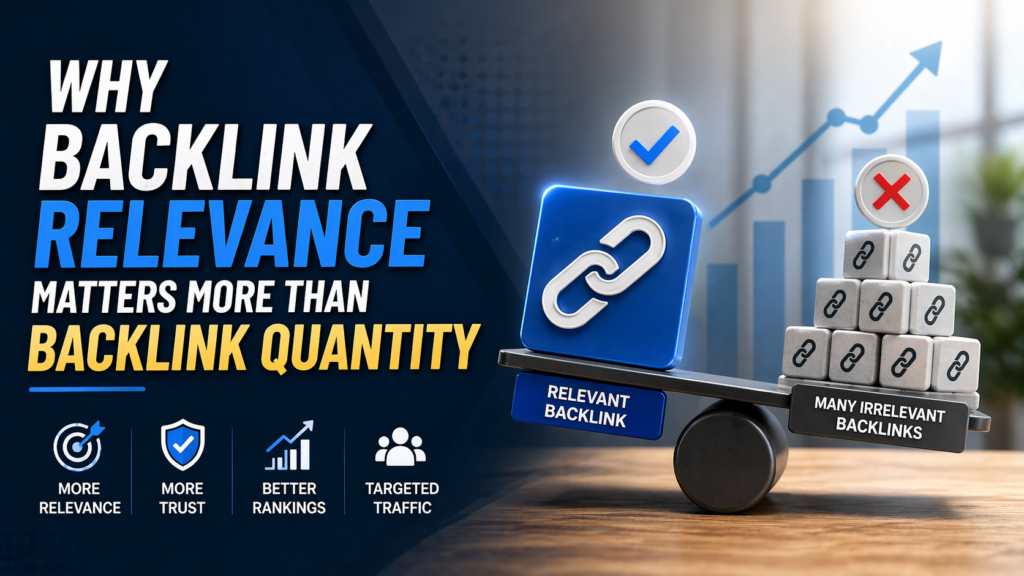
Backlink relevance means how closely the linking website, page, and anchor context match the topic of the page receiving the link. In modern SEO, relevance influences ranking strength more than raw backlink volume because Google evaluates links as contextual trust signals, not simple votes.
Google’s original PageRank model treated backlinks as authority signals, but modern search systems prioritize topical alignment, user intent, and content quality alongside authority. Google’s own ranking evolution and industry analysis consistently show that fewer relevant backlinks often outperform hundreds of unrelated links. TechRadar’s 2025 SEO tool analysis also notes that link building has shifted from volume-focused tactics toward targeted, high-quality human-user benefits.
This article explains what backlink relevance is, why it matters more than quantity, how Google evaluates relevant links, common mistakes businesses make, and how to build a relevance-first backlink strategy for long-term rankings.
What Is Backlink Relevance?
Backlink relevance is the contextual relationship between the referring page and the destination page.
A backlink is considered relevant when the linking website covers a similar subject, serves a related audience, and places the link naturally within useful content. Search engines treat this as a stronger editorial endorsement than links from unrelated websites.
For example:
- A SaaS SEO tool getting a backlink from a digital marketing publication = highly relevant
- The same SaaS tool getting a backlink from a random fashion blog = low relevance
Wikipedia’s backlink definition also notes that backlinks from authoritative sites on a given topic are highly valuable because topical congruency strengthens ranking influence.
Relevance vs Authority
Authority and relevance are not the same thing.
A high-authority website can still provide a weak backlink if the topic relationship is poor. Likewise, a smaller niche website can provide strong ranking value if it is highly relevant.
| Factor | Meaning | SEO Value |
| Authority | Trust and reputation of the domain | Helps transfer ranking power |
| Relevance | Topic match between linking and target pages | Helps transfer contextual trust |
| Placement | Natural editorial position of the link | Improves credibility |
| Traffic Potential | Real user click opportunity | Supports behavioral trust |
The strongest backlinks combine all four.
Why Backlink Relevance Matters More Than Quantity
Backlink relevance matters more than quantity because Google now evaluates link quality through context, not simple counting.
Older SEO strategies focused on collecting as many backlinks as possible. This worked during early PageRank-driven ranking systems, but Google’s Penguin updates and semantic search systems significantly reduced the value of mass low-quality links.
Today, one relevant editorial backlink can outperform dozens of irrelevant links.
Search Engines Prioritize Context
Google uses systems like semantic analysis and spam detection to understand whether a link makes sense in context.
If a cybersecurity company gets linked from a cybersecurity research blog, that link reinforces expertise and trust. If the same company gets links from unrelated coupon sites, those links often pass little ranking value.
Industry experts across Reddit’s SEO and Digital Marketing communities also consistently describe backlinks as “trust signals” where niche relevance matters more than total link count.
Link Quantity Alone Can Create Risk
High backlink volume without relevance often signals manipulation.
Examples include:
- Paid link schemes
- PBN links
- Irrelevant guest posting
- Directory spam
- Footer link farms
Google’s Penguin system was specifically designed to devalue these patterns, not reward them.
User Intent Alignment Improves Rankings
Relevant backlinks improve more than rankings—they improve click quality.
A backlink from the right audience sends qualified traffic, stronger engagement, and clearer intent signals. Search engines increasingly use these behavioral indicators to validate trust.
TechRadar highlights that modern link building focuses more on attracting targeted users than “gaming algorithms.”
How Google Evaluates Relevant Backlinks
Google evaluates backlink relevance through topical alignment, source trust, placement, and user value.
Topical Similarity
The linking domain should serve a related subject area.
Examples:
- Finance → finance publications
- Medical → healthcare journals
- SEO → marketing and digital growth websites
Topical mismatch weakens value even when domain authority is high.
Page-Level Context
The specific page linking to you matters more than the homepage.
A relevant article inside a niche publication is stronger than a generic site-wide mention.
Example:
A backlink inside a guide on “international SEO strategies” is stronger than a random homepage footer link.
Natural Editorial Placement
Google values links embedded naturally inside useful content.
Strong placements include:
- Editorial mentions
- Case studies
- Research citations
- Resource pages
- Expert interviews
Weak placements include:
- Author bio stuffing
- Sponsored spam posts
- Sidebar link dumps
Anchor Text Relevance
Anchor text helps search engines understand what the linked page is about.
Natural examples:
- “technical SEO audit process”
- “enterprise link building strategy”
Manipulative examples:
- exact-match repetition
- forced keyword stuffing
Anchor diversity is safer and stronger.
Quantity Still Matters—But Only After Relevance
Backlink quantity still matters, but only when relevance and quality are already strong.
A site with ten highly relevant editorial backlinks can outrank a site with 500 weak links. However, once relevance is established, broader link velocity and authority growth help scale rankings.
This is where many SEO strategies fail—they pursue scale before quality.
The Right Sequence
The correct order is:
- Relevance
- Authority
- Editorial trust
- Quantity
Not the reverse.
This prevents wasted budget and algorithmic risk.
Common Backlink Mistakes Businesses Make
Many businesses still measure backlinks using outdated quantity-first metrics.
This creates poor investments and unstable rankings.
Buying Bulk Links
“100 backlinks for $50” remains one of the most common SEO mistakes.
Cheap links usually come from irrelevant, low-trust sites and create long-term cleanup costs rather than ranking growth.
Ignoring Referral Traffic
A backlink that sends no real users often has weak practical value.
Strong backlinks should create both SEO signals and business visibility.
Chasing DA Without Relevance
Domain Authority alone is not a ranking factor.
A DA 30 niche publication can outperform a DA 90 unrelated website.
Overusing Guest Posts
Guest posting works only when the site is truly relevant and editorial standards are strong.
Mass guest posting for anchor text manipulation often produces weak links.
Relevance-First Link Building Strategy
The best backlink strategy starts with earning links that make sense.
Create Linkable Assets
Useful content attracts relevant backlinks naturally.
Examples:
- original industry research
- statistics pages
- comparison guides
- calculators
- expert commentary
- infographics
These assets create citation opportunities.
Build Industry Relationships
PR, partnerships, and expert collaborations generate stronger links than cold outreach alone.
Relevant links are often relationship-driven.
Analyze Competitor Link Gaps
Competitor backlink analysis helps identify where relevant opportunities already exist.
Look for:
- industry publications
- resource pages
- local associations
- editorial contributors
This reveals realistic acquisition targets.
Audit and Remove Harmful Links
Low-quality irrelevant links should be reviewed regularly.
Sometimes disavowal is necessary, but strategic cleanup matters more than aggressive removal.
The Hidden Cost of Quantity-First SEO
Cheap link volume often creates invisible long-term costs.
These include:
- ranking volatility
- wasted outreach budget
- manual penalty recovery
- trust erosion
- poor lead quality
Short-term link spikes frequently become long-term ranking problems.
This is why serious SEO strategies focus on sustainable authority, not backlink inflation.
Beyond Relevance: Topical Authority
The next stage after relevant backlinks is topical authority.
Google increasingly evaluates whether your entire site consistently demonstrates expertise across a specific subject area. Relevant backlinks strengthen this ecosystem by helping search engines understand that your website is trusted within its niche, but they work best when paired with strong internal content depth and consistent topical coverage.This is where advanced backlink strategies become less about simply “getting backlinks” and more about building a recognized authority within your industry. At TBS Marketing, our approach focuses on securing highly relevant backlinks through strategic outreach, niche editorial placements, and authority-driven link acquisition helping businesses build long-term SEO strength rather than short-term ranking spikes.
