
Every high-quality backlink pointing to your website holds substantial ranking potential, yet without the proper internal architecture, that value remains trapped on isolated pages like water in a blocked pipe. Internal linking serves as the circulatory system of your site, connecting pages within the same domain via hyperlinks to distribute this accumulated authority throughout your entire domain. Recent analysis of 23 million internal links reveals the stark reality: URLs receiving 40 to 44 contextual internal links generate four times more organic traffic than those with fewer than five, demonstrating that your backlink portfolio only reaches its full potential when supported by strategic internal pathways.
To fully understand how this authority is created in the first place, it helps to revisit what backlinks are and why they remain a core ranking signal in modern SEO.
Recent analysis of 23 million internal links reveals the stark reality: URLs receiving 40 to 44 contextual internal links generate four times more organic traffic than those with fewer than five. This demonstrates that backlinks only deliver full SEO value when supported by strategic internal pathways.
What Is Internal Linking?
Internal linking encompasses hyperlinks that point from one page of a domain to another page within that same domain. Unlike external backlinks, internal links remain entirely under your control, allowing precise optimisation of how authority flows through your site. According to Search Engine Land, contextual links embedded within the main content body pass significantly more equity than navigational elements in footers or sidebars because they represent deliberate editorial endorsements rather than template-based navigation.
From an operational standpoint, internal linking is a fundamental component of effective backlink management, as it determines how externally earned authority is distributed across priority pages.
According to Search Engine Land, contextual links embedded within the main content body pass significantly more equity than navigational elements in footers or sidebars because they represent deliberate editorial endorsements rather than template-based navigation.
How Internal Linking Impacts Backlink Value
Link equity refers to the ranking power passed between pages through hyperlinks. While external backlinks provide foundational authority, internal links function as the distribution network that amplifies their value.
PageRank Distribution
When a page earns high-quality external backlinks, it accumulates substantial authority. Search Engine Land confirms that this authority flows to connected pages through strategic internal links, effectively allowing one strong backlink to elevate multiple URLs across your site.
This mechanism plays a critical role in reinforcing trust signals tied to E-A-T and topical authority, especially for commercial and service-led pages.
Without internal connections, valuable equity remains trapped on isolated pages.
Anchor Text Optimisation
Research into 23 million internal links indicates that pages utilising exact-match anchor text from internal links received five times more organic traffic than those without such specificity. This semantic signalling helps Google understand page relevance and supports broader link building strategies.
Empirical Evidence
A comprehensive study of 23 million internal links across 1,800 websites provides definitive benchmarks. URLs with 40 to 44 unique contextual internal links achieved four times the Google Search clicks of URLs with only zero to four links.
However, performance peaks at approximately 45 links before declining, as excessive links typically indicate sitewide navigational elements rather than unique editorial recommendations.
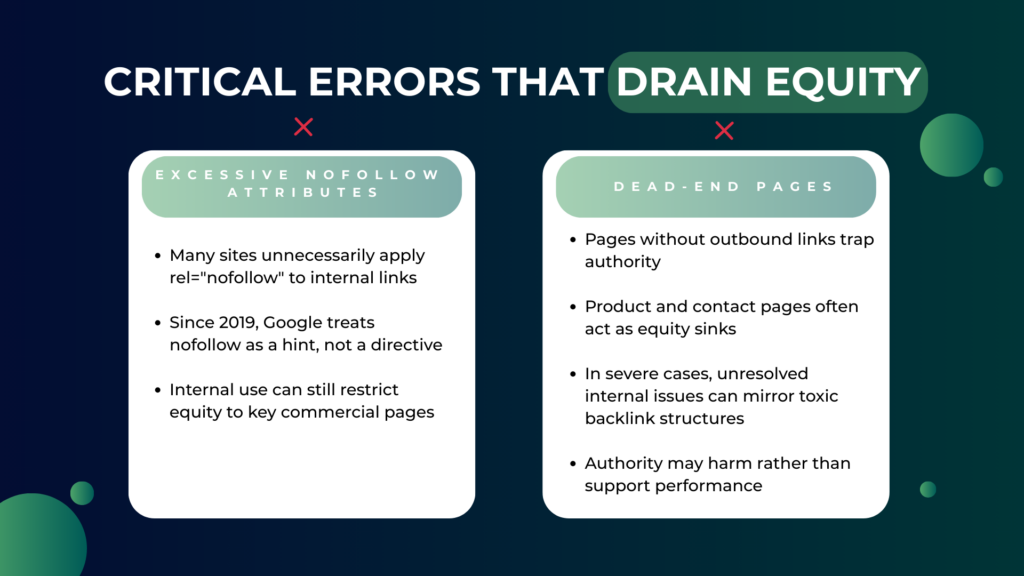
Critical Errors That Drain Equity
While effective internal linking amplifies backlink value, technical mistakes create equity sinks that waste authority.
Excessive Nofollow Attributes
Many sites unnecessarily apply rel=”nofollow” to internal links. Although Google has treated nofollow as a hint rather than a directive since 2019, widespread internal application still prevents equity flow to important commercial pages and mirrors common backlinking mistakes.
Dead-End Pages
Pages lacking outbound links trap authority. Product pages and contact forms are common equity sinks where accumulated value benefits no other content.In severe cases, unresolved internal issues can resemble structural problems similar to toxic backlink scenarios, where authority actively harms rather than helps performance.
Conclusion
Internal linking directly multiplies backlink value by distributing PageRank from externally linked authority pages throughout your site architecture. Evidence demonstrates that strategic implementation can quadruple organic traffic, while industry analysis confirms these mechanisms remain critical in modern search algorithms.
For businesses competing in UK and ASEAN markets, internal linking offers the highest-return SEO activity under direct control. Audit your current architecture to identify orphan pages, map authority flows from high-backlink URLs to priority commercial content, and maintain contextual relevance in your anchor text.
Ready to maximise your existing backlink profile? Contact Thaiseolink to learn how we provide technical audits and implementation strategies tailored for your market.
